How Often Should You Take Screen Breaks? A Desk-Day Plan
By ScreenSky · · Updated
Combine brief look-away pauses with longer changes of activity. Adapt an example desk-day schedule to meetings and see what occupational guidance recommends.

On this page
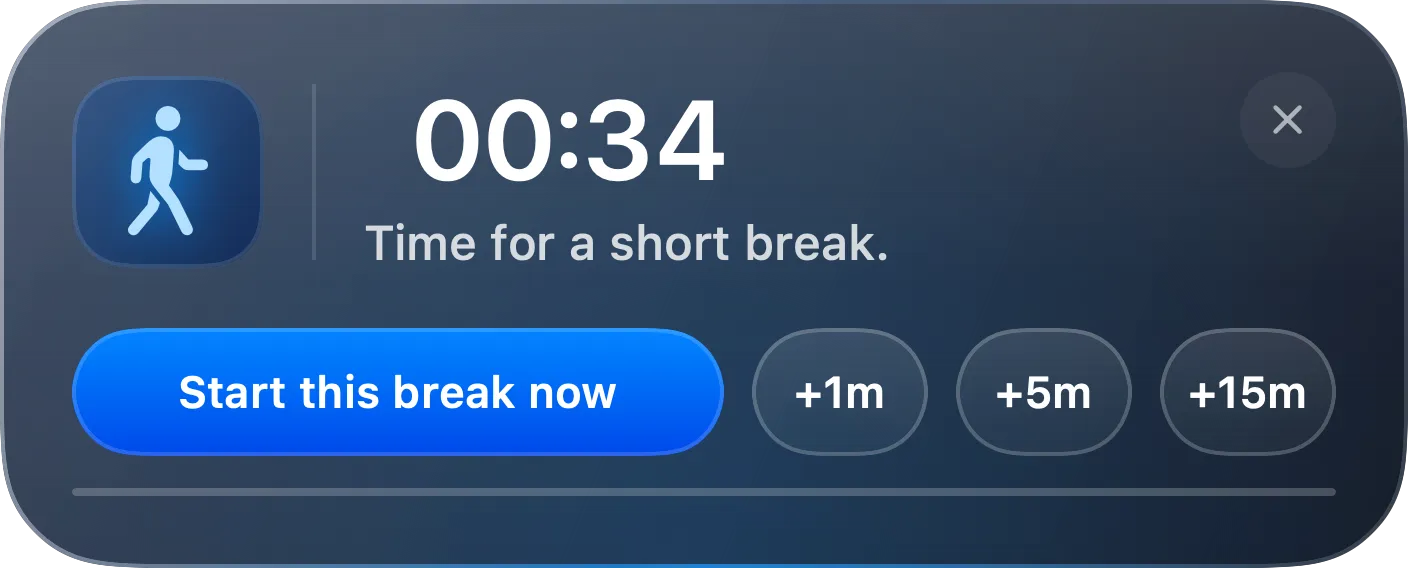
Start with a short pause you can repeat and a longer break you can protect. For a 9-to-5 day, try a brief pause after about half an hour of uninterrupted desk work, a longer break midmorning, and lunch away from the screen when possible. Use this as a starting schedule and move the pauses around your calls, shifts, and existing breaks.
An example for a 9-to-5 workday
| Time | What to try |
|---|---|
| 9:00–10:30 | Use a couple of short pauses to look away or change position. |
| Around 10:30 | Take a longer break. Get a drink or move away from the desk if you can. |
| Late morning | Put a short pause in the gap between calls or tasks. |
| At lunch | Take your usual lunch break away from your main screen when possible. |
| Early afternoon | Restart the reminder for the first stretch of uninterrupted work. |
| Midafternoon | Protect another longer break before your final work block. |
OSHA’s computer workstation guidance suggests fitting short pauses or changes of activity into prolonged computer work. The times above are examples for organizing a day. Use the breaks and meal periods that apply to your workplace.
Change the schedule where it breaks down
If the midmorning break keeps landing during a meeting, take it after that meeting ends and protect the next few minutes on your calendar. If reminders disappear late in the afternoon, try a cue you can see from your main window. Start with one consistent work block if writing down your entire day feels like extra work.
Use the same schedule twice before changing it. Note which pauses you actually took and where you needed more room. Then change the part that collided with the way you work.
How often is a useful starting point?
For a simple eye-break habit, try the 20-20-20 rule. For a longer change of activity, protect time away from the workstation around the work you do. The two pauses serve different purposes; a brief distant look does not provide the same movement opportunity as leaving the desk.
HSE’s display-screen guidance favors short, frequent breaks and gives 5–10 minutes each hour as an example preferable to 20 minutes every two hours. It does not prescribe one interval for every kind of work. This is UK occupational guidance, not a universal entitlement or personalized treatment schedule.
Make a backup for meetings
If a call consumes the planned pause, choose the next feasible transition. Write the return note before getting up, and avoid using the whole gap for another close-up task on your phone.
Keep a simple record for a few days: planned pause, whether it happened, and what prevented it. If the same meeting causes every miss, change that part of the plan rather than shortening all work blocks indiscriminately.
What this schedule cannot establish
The example above organizes a day; it has not been clinically tested as a complete routine. A timer is a cue, not evidence that enough rest was taken. Persistent symptoms need appropriate assessment, and workplace break arrangements depend on your job and location.
Sources
- OSHA guidance on work breaks and workstation setup (checked )
- ScreenSky adjustable browser work-break timer (checked )
- HSE: Work routine and breaks (checked )