Make Break Reminders Less Annoying: Timing, Typing and Snooze
By ScreenSky · · Updated
Test advance warnings, typing detection and snooze around real work. Keep a visible next step so a break is easier to take and easier to return from.


On this page
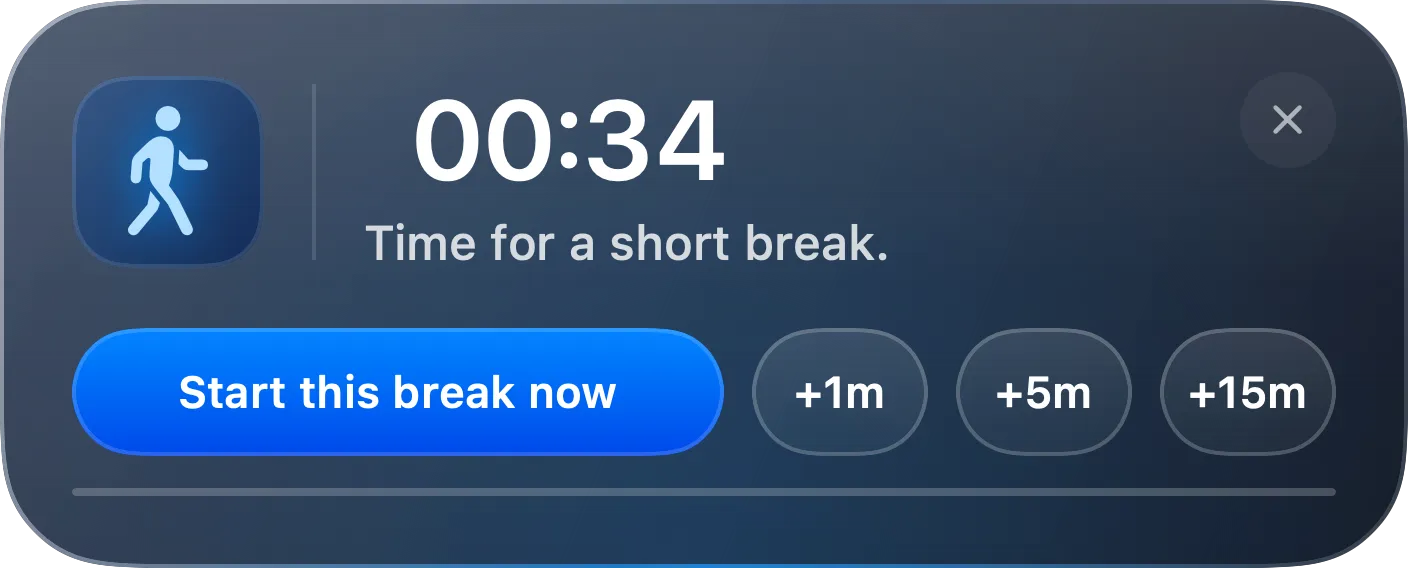
Look for a reminder that gives you a warning, holds the break during active typing, and resumes once you stop. ScreenSky can hold the final countdown while you type. LookAway documents typing detection as part of its Smart Pause features. Try whichever you choose in the editor or terminal where an interruption would bother you most.

Find out which part of the timer pauses
There are two behaviors worth checking. A timer can hold the last few seconds and begin the break shortly after you stop, or it can pause a longer part of the work interval. Those feel different when you type for ten minutes at a stretch. Read the app’s description of the setting and watch the countdown to see which behavior it uses.
Typing and reading also pose different problems. If you are halfway through a long pull request without touching the keyboard, see whether the advance warning gives you enough time to finish the paragraph or postpone the break yourself.
Test it with a rough draft you can discard
- Schedule a short trial break and open a blank document.
- Start a sentence just before the countdown reaches its end.
- Finish the sentence, take your hands off the keyboard, and watch whether the timer resumes.
- Let a second reminder fire while you read without typing. Note what the app does in each case.
Run the same test with your usual keyboard if you switch between a laptop and a dock. You will know whether you can rely on the setting or should leave the snooze control within reach.
Separate a bad moment from an invisible cue
After a missed pause, note what happened. Did the reminder disappear before you saw it? Did you see it during a call? Did you dismiss it because you could not remember where to resume?
Each observation suggests a different adjustment: a clearer cue, a better time or a more useful return note. Increasing the number of prompts does not solve all three problems.
Use a next-step note to lower the cost of stopping
Before a break, write one action and its location: “Open the failed export log and check the second timestamp.” When you return, follow that note before opening messages.
For reading-heavy work, keep an advance warning and accessible defer control in mind. Typing detection cannot tell whether you are in the middle of an important paragraph while your hands are still.
Check whether deferring becomes permanent
Try the routine across a coding block, a review and a call. Record taken, deferred or missed pauses without turning the record into a health score. If every break is deferred, revisit the schedule or workload instead of assuming stricter controls are automatically better.
This guide describes a practical evaluation. It is not a claim that a particular reminder prevents eye disease or that the same pause settings suit every person.
Sources
- ScreenSky typing detection and final countdown (checked )
- LookAway Smart Pause and typing detection (checked )